If you’ve lived in Karachi, you already know the feeling — stepping outside in June and being hit by a wall of heat so thick and moist it feels less like air and more like warm soup. With temperatures regularly climbing above 35°C and humidity levels hovering between 70% and 90% during the monsoon-adjacent months, Karachi’s summer is not just hot — it’s relentlessly, oppressively humid.
And yet, millions of people get dressed every single morning and go about their lives. The difference between someone who manages the heat gracefully and someone who spends the day drenched in sweat and discomfort often comes down to one fundamental choice: the fabric they’re wearing.
This guide is a deep dive into the science and practicality of fabric selection for Karachi’s unique climate. Whether you’re shopping for everyday shalwar kameez, office wear, casual outfits, or even workout clothes, understanding how different textiles behave in high heat and humidity will completely transform your summer wardrobe — and your comfort.
Understanding Karachi’s Climate: Why Fabric Choice Matters More Here Than Almost Anywhere
Before we get into specific fabrics, it helps to understand exactly what your clothes are up against.
Karachi sits on the Arabian Sea coast and experiences a hot semi-arid climate with a brief but intense monsoon influence. The summers — particularly from May through September — are defined by:
- High temperatures: Daytime highs between 33°C and 42°C are common, with heat waves occasionally pushing into the mid-40s.
- Extreme humidity: Especially from June to August, relative humidity regularly exceeds 80%, and on many days it approaches 95–100%.
- Sea breezes: These can offer momentary relief, but they also carry moisture, keeping the air thick even when there’s a wind.
- Minimal rainfall: Unlike interior Pakistan, Karachi gets very little rain even during monsoon months, meaning there’s no evaporative cooling from wet ground.
- Urban heat island effect: The dense concrete cityscape traps heat, making urban Karachi several degrees hotter than surrounding areas.
What does all of this mean for your wardrobe? Your body’s primary cooling mechanism — sweating — becomes significantly less effective in high humidity. Sweat evaporates slowly when the air is already saturated with moisture, so heat builds up inside your clothing. The wrong fabric acts like a trap, holding that heat and sweat against your skin and making everything worse. The right fabric, by contrast, wicks moisture, allows airflow, and creates a microenvironment against your skin that is dramatically cooler than the outside air.
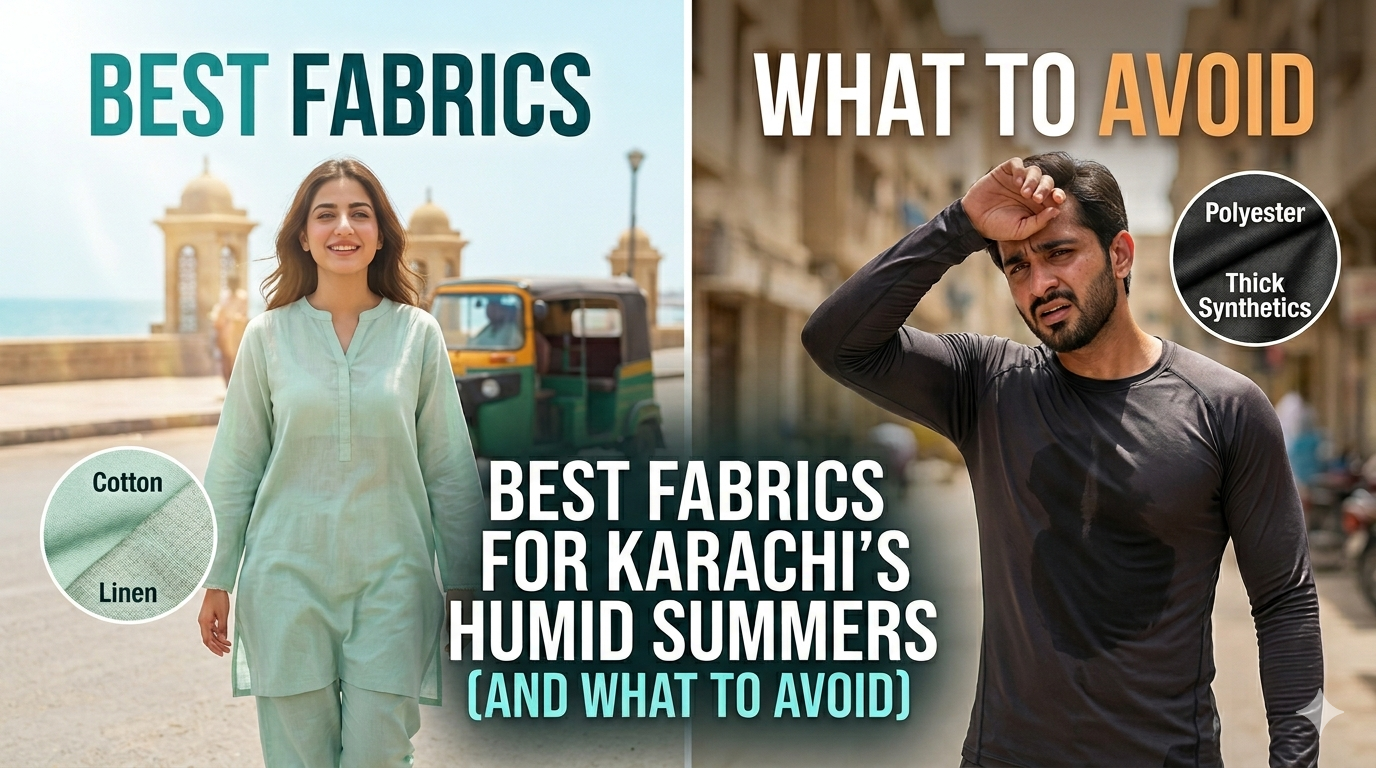
The Best Fabrics for Karachi’s Humid Summers
1. Cotton — The Gold Standard for a Reason
Breathability: ⭐⭐⭐⭐⭐
Moisture Absorption: ⭐⭐⭐⭐⭐
Comfort in Humidity: ⭐⭐⭐⭐
Availability in Pakistan: ⭐⭐⭐⭐⭐
Cotton is Pakistan’s most iconic crop and Karachi’s most beloved summer fabric — and for very good reason. Cotton is a natural, plant-based fiber made primarily of cellulose, and its molecular structure makes it exceptionally good at absorbing moisture. It can hold up to 27 times its own weight in water before it starts to feel wet against your skin, which means it quietly manages perspiration far longer than synthetic alternatives.
Why cotton works in Karachi:
- High absorbency means it draws sweat away from your skin before it begins to pool and cause discomfort.
- Natural breathability allows air to circulate through the weave, helping your body regulate its temperature.
- Soft and non-irritating against skin, which matters enormously when you’re sweating throughout the day.
- Widely available and affordable across every market in Karachi, from Tariq Road to Zainab Market to high-end boutiques.
Best types of cotton for Karachi summers:
- Lawn cotton: This is the reigning queen of Pakistani summer fabrics. Lawn is a plain-weave cotton (or cotton blend) with an extremely fine, lightweight construction. It’s nearly translucent in its pure form, breathes like a dream, and is the reason the Pakistani fashion industry produces thousands of lawn collections each season. For women especially, lawn is unmatched.
- Voile cotton: Similar to lawn but with a slightly more open weave and a crisper feel. Voile is excellent for dupattas, overlayers, and lighter garments.
- Cambric cotton: Slightly heavier than lawn, cambric has a smooth, semi-lustrous finish. It’s a workhorse fabric — good for everyday shalwar kameez that needs to look pressed and put-together.
- Khaddar (summer-weight): Traditional hand-loomed cotton with a slightly textured surface. The lighter summer-weight versions are surprisingly breathable and add a lovely texture to casual and semi-formal outfits.
- Cotton poplin: A tightly woven, smooth cotton fabric used widely in men’s formal shirts. It holds its shape, takes a good press, and remains breathable enough for office environments.
One important caveat: In Karachi’s extreme humidity, cotton does saturate eventually. On the most brutal days — mid-August with 90%+ humidity — even a good cotton shirt will feel damp by midday. Choosing loose, flowing cuts (as opposed to fitted silhouettes) significantly extends cotton’s comfort window.
2. Linen — The Sophisticated Choice for Serious Heat
Breathability: ⭐⭐⭐⭐⭐
Moisture Absorption: ⭐⭐⭐⭐⭐
Comfort in Humidity: ⭐⭐⭐⭐⭐
Availability in Pakistan: ⭐⭐⭐
If cotton is the everyday hero of Karachi summers, linen is the distinguished elder — less common, slightly more expensive, but arguably superior in the most punishing heat. Linen is derived from the flax plant and has a molecular structure that makes it even more breathable than cotton. It absorbs moisture quickly and, crucially, dries faster than cotton, which makes it better suited for extremely humid conditions where you need a fabric that can cycle through moisture rapidly.
Why linen excels in high humidity:
- Hollow fiber structure: Linen’s fibers have a natural hollow core that allows for superior air circulation. This creates a passive cooling effect — a kind of built-in ventilation system.
- Dries rapidly: Unlike cotton, which can stay damp once saturated, linen releases moisture back into the air relatively quickly. This means it can go through multiple sweat cycles in a long day and still feel relatively dry.
- Gets softer with wear and washing: Quality linen improves over time, becoming more comfortable the more it’s worn.
- Antimicrobial properties: Linen has a natural resistance to bacteria, which helps prevent the musty odor that humid conditions can cause in other fabrics.
- Temperature-regulating: Linen keeps you cool when it’s hot and provides a subtle insulating effect in cooler (air-conditioned) environments.
Best uses for linen in Karachi:
- Men’s dress shirts and casual kurtas
- Women’s straight-cut shalwar kameez in lightweight linen blends
- Wide-leg trousers and palazzo pants
- Blazers and structured jackets for formal or office settings where a polished look is needed
The wrinkle issue: Linen’s biggest drawback is its tendency to wrinkle almost instantaneously. The moment you sit down, stand up, or breathe near a linen garment, it creases. In Karachi’s fashion culture, where crisp, well-pressed clothes are often expected in formal and office contexts, this can be a limitation. However, many people have embraced linen’s natural crinkle as part of its character, particularly in casual settings. Linen-cotton blends offer a middle ground — better wrinkle resistance while retaining most of linen’s breathability benefits.
3. Bamboo Fabric — The Modern Underdog
Breathability: ⭐⭐⭐⭐
Moisture Absorption: ⭐⭐⭐⭐⭐
Comfort in Humidity: ⭐⭐⭐⭐⭐
Availability in Pakistan: ⭐⭐
Bamboo fabric is a relatively newer entrant in Pakistani fashion circles, but it deserves serious attention from anyone dressing for Karachi’s summers. Bamboo fabric is typically made through a viscose process that breaks down bamboo pulp into a soft, silk-like fiber. When done right (look for bamboo linen or mechanically processed bamboo), it is one of the most impressive natural-source fabrics for hot, humid environments.
Why bamboo works:
- Exceptional moisture-wicking: Bamboo fabric pulls sweat away from the skin and moves it to the fabric’s surface where it can evaporate. This process — called moisture-wicking — is far more active than the passive absorption of cotton.
- Thermo-regulating: Bamboo fabric has microscopic gaps in the fiber structure that passively regulate temperature, keeping you cool in heat and less chilly in strong AC.
- Naturally antibacterial: Bamboo contains a bio-agent called “bamboo kun” which resists bacteria growth, reducing body odor — a significant concern in Karachi’s humidity.
- Incredibly soft: Bamboo fabric is often compared to cashmere in softness, making it gentle on skin that may be sensitized by heat rash or prickly heat.
- Hypoallergenic: Ideal for those with sensitive skin who suffer from rashes during summer.
Availability note: Bamboo fabric is harder to find in local Karachi markets and tends to be imported, making it pricier. However, it’s increasingly available through online retailers, and high-end local brands have begun incorporating it into their summer collections.
4. Modal — Softness Meets Performance
Breathability: ⭐⭐⭐⭐
Moisture Absorption: ⭐⭐⭐⭐⭐
Comfort in Humidity: ⭐⭐⭐⭐
Availability in Pakistan: ⭐⭐⭐
Modal is a semi-synthetic fabric made from beechwood cellulose. It sits in an interesting category — more processed than linen or cotton, but still derived from a natural source. Modal has become popular in premium casual wear, innerwear, and activewear.
Why modal is worth considering:
- 50% more moisture absorbent than cotton, making it exceptional at managing sweat in high-humidity environments.
- Extremely soft and smooth, reducing friction-related skin irritation in sweaty conditions.
- Wrinkle-resistant, giving it an advantage over linen for those who want a neat appearance.
- Good color retention — modal holds dye very well, meaning your summer clothes stay vibrant even after many washes.
- Lightweight — modal drapes beautifully, making it excellent for flowy summer silhouettes.
Modal is particularly popular in innerwear and undershirts, where its moisture management can make the most difference. Wearing a well-made modal undershirt beneath dress clothes can dramatically improve comfort in Karachi’s heat.
5. Chambray — The Linen Look Without the Wrinkles
Breathability: ⭐⭐⭐⭐
Moisture Absorption: ⭐⭐⭐⭐
Comfort in Humidity: ⭐⭐⭐⭐
Availability in Pakistan: ⭐⭐⭐
Chambray is a plain-weave fabric typically made from cotton, constructed using a colored yarn in the warp and a white yarn in the weft, giving it a distinctive soft, denim-like appearance without denim’s weight or stiffness. It’s often mistaken for lightweight denim but is dramatically more breathable.
Why chambray works for Karachi summers:
- Lightweight and airy compared to heavier weaves
- Casual and versatile — works for informal office settings, weekend outings, and relaxed social occasions
- Breathes well while looking more “put together” than a simple cotton tee
- Good for men’s shirts in particular — a chambray shirt in light blue or white can pass for business casual in many Karachi workplaces while keeping you significantly cooler than a formal poplin shirt
6. Mul Mul (Muslin) — The Ancient Pakistani Solution
Breathability: ⭐⭐⭐⭐⭐
Moisture Absorption: ⭐⭐⭐⭐
Comfort in Humidity: ⭐⭐⭐⭐⭐
Availability in Pakistan: ⭐⭐⭐⭐⭐
Mul mul, also known as muslin, is one of the oldest fabrics in South Asian history and one of the most perfectly suited for the subcontinent’s punishing summers. Made from finely spun cotton threads woven into a loose, open weave, mul mul is extraordinarily lightweight — almost like wearing air.
Why mul mul is ideal for Karachi:
- Open weave construction allows maximum airflow against the skin
- Very lightweight — some varieties weigh as little as 30–35 grams per meter
- Soft and non-clingy — doesn’t stick to sweaty skin the way tighter weaves do
- Traditional and culturally appropriate — mul mul dupattas, suits, and kurtas are a staple of the South Asian wardrobe and are widely available and affordable
- Excellent for sleepwear and loungewear on hot nights
The one limitation of mul mul is its delicacy. The open weave means less structural integrity, and it can tear more easily than sturdier cottons. It also provides very little sun protection, which is relevant for outdoor wear in Karachi’s intense sunlight. Many people layer mul mul garments or choose slightly denser versions for outdoor use.
Fabrics to Avoid in Karachi’s Humid Summers
Understanding what to avoid is just as important as knowing what to wear. The following fabrics will make your Karachi summer significantly more miserable:
1. Polyester — The Heat Trap
Polyester is the enemy of the Karachi summer wardrobe, full stop. As a petroleum-derived synthetic fiber, polyester has almost no moisture absorption capacity — it holds less than 1% of its weight in water. Sweat cannot be absorbed; it can only pool on the surface of your skin or be trapped between the fabric and your body.
Why polyester is a disaster in humidity:
- Zero breathability — the tight weave and non-porous fiber structure create a barrier that traps heat like a greenhouse
- Sweat accumulates against your skin with nowhere to go, creating discomfort, chafing, and strong odor
- Static electricity builds up in dry-to-moderate humidity conditions, causing the fabric to cling unpleasantly to your body
- Odor retention — polyester is notorious for retaining bacteria-produced odors even after washing; in Karachi’s heat, this becomes a serious hygiene issue
- Feels hot to the touch — synthetic fibers can actually raise your skin surface temperature by several degrees compared to natural fabrics
The cruel irony is that polyester is ubiquitous in Pakistani markets because it’s cheap, wrinkle-resistant, and easy to produce in bright colors. Many mass-market shalwar kameez and formal wear pieces are made from polyester or polyester blends. Always check fabric labels and do the “breathe through it” test — hold the fabric up to your lips and blow gently. If air passes through easily, it’s breathable. If it resists, walk away.
2. Nylon — Breathability’s Opposite
Like polyester, nylon is a petroleum-based synthetic with very low breathability and poor moisture management. It was designed for strength and durability (think stockings and sportswear), not for comfort in heat.
Problems with nylon in humid heat:
- Creates a sealed, non-breathable layer against the skin
- Holds sweat and body heat in, causing discomfort and potential heat-related issues on very hot days
- Can cause skin irritation and prickly heat in sensitive individuals
- Dries slowly despite not absorbing moisture, simply because sweat has nowhere to go
The only context where nylon can be acceptable in Karachi summers is in very lightweight athletic mesh forms specifically designed for moisture-wicking — and even then, it’s usually inferior to newer performance fabrics or natural alternatives.
3. Rayon and Viscose — The Deceptive Imposters
Rayon and viscose are technically “semi-synthetic” fabrics made from wood pulp that has been heavily chemically processed. They’re often marketed as “breathable” or even as alternatives to silk, and they do have a soft, flowing drape that makes them popular in summer fashion.
The problem with rayon/viscose in Karachi:
- While rayon does absorb moisture, it loses significant strength when wet. In high humidity, rayon garments can stretch out of shape, sag, and become limp and heavy very quickly.
- Rayon dries very slowly, meaning once it absorbs your sweat, it holds it — creating that uncomfortable damp, heavy feeling that clings to your skin.
- It requires dry cleaning or very gentle washing, making it impractical for daily summer wear that needs frequent laundering.
- Poor quality rayon (widely available in Karachi’s wholesale markets) pills, shrinks, and deteriorates rapidly.
Some high-quality viscose blends — particularly viscose-linen or viscose-cotton — can be acceptable, but pure rayon or viscose is generally not a good choice for Karachi’s particularly humid summer conditions.
4. Silk — Beautiful but Demanding
Pure silk is a natural fiber with genuinely good breathability and some moisture management, but it comes with so many practical limitations for Karachi summers that it belongs on the “avoid for daily wear” list.
Why silk is problematic in Karachi’s heat:
- Sweat stains easily and permanently — perspiration and body oils can cause irreversible yellowing and water spots on silk
- Extremely sensitive to humidity — pure silk can stretch, deform, and lose its luster when exposed to prolonged humidity
- Requires delicate care — most silk needs to be dry-cleaned, making it impractical for frequent summer washing
- Expensive to maintain in the quantities required for Karachi’s long, sweaty summer
Silk is best reserved for special occasions — a wedding event, an Eid dinner — where you’re likely in air-conditioned environments and not sweating heavily. It is absolutely not a fabric for daily use in Karachi’s summer streets.
5. Denim — The Obvious Culprit
Denim jeans and heavy denim jackets are thoroughly unsuitable for Karachi summers, yet many people — particularly younger urban residents influenced by global fashion trends — continue to wear them. The numbers tell the story: standard denim weighs 8 to 14 ounces per square yard, compared to lawn cotton at 1 to 2 ounces. You are literally carrying many times more fabric weight in a denim outfit.
Why denim fails in Karachi’s humidity:
- Heavy and insulating — traps body heat with remarkable efficiency
- Almost no breathability in standard weights
- Dries extremely slowly — if denim gets saturated with sweat (which it will in Karachi summers), it stays uncomfortably damp for hours
- Chafing risk increases significantly when denim is wet against skin in humid conditions
- Dyeing issues — cheap denim can bleed blue dye when wet with sweat, staining skin and other garments
If you love the denim aesthetic, look for lightweight denim alternatives — chambray, as described above, or stretch denim blends in very light weights (under 6 oz) — which can work in moderately humid conditions.
6. Wool and Heavy Knits
This might seem obvious, but it bears stating: wool, cashmere, and heavy knit fabrics are completely inappropriate for Karachi summers. Even “lightweight” wool — the kind sometimes recommended for temperate summer climates — is too insulating and moisture-retentive for Karachi’s extreme conditions. The only exception would be in heavily air-conditioned environments (some Karachi offices keep temperatures uncomfortably cold), where a light wool layer can actually be useful — but you’d want to change immediately upon heading outside.
Practical Tips for Managing Fabric in Karachi’s Summer
Choosing the right fabric is step one. Here’s how to maximize comfort with your fabric choices:
Choose Loose, Flowing Silhouettes
No matter how breathable a fabric is, a tight-fitting garment will trap heat. The traditional South Asian silhouette — loose shalwar, wide-cut kameez, flowing dupattas — was developed over centuries precisely because it works in this climate. Garments that allow air to circulate between the fabric and your skin are dramatically more comfortable than fitted Western-style clothing.
Light Colors Reflect Heat
White, light grey, pastel blues, creams, and soft yellows reflect solar radiation rather than absorbing it. In Karachi’s intense sunlight, wearing dark colors in natural fabrics can negate some of the breathability advantage — a dark navy cotton can heat up nearly as much as a light-colored synthetic. For outdoor use, always lean toward lighter shades.
Layer Strategically
The concept of layering in summer sounds counterintuitive, but a lightweight inner layer of moisture-wicking fabric (bamboo, modal, or quality cotton) can actually protect your outer garments from sweat saturation. This is particularly useful for office workers who want to maintain a polished appearance throughout a long day.
Read Labels and Don’t Trust Marketing
“Summer collection” means nothing without fabric information. Always check the composition label. A garment labeled as “summer lawn” could be 100% lawn cotton or could be a polyester blend — these are completely different experiences. Look for: 100% cotton, 100% linen, bamboo blends, modal, or muslin/mul mul designations.
Store Properly During Off-Season
Humidity can damage natural fabrics during Karachi’s slightly less extreme winter months. Store cotton and linen garments in breathable cotton bags (not plastic) with moisture-absorbing silica gel packets to prevent mildew, which is a real concern in Karachi’s year-round humidity.
Wash More Frequently in Summer
Natural fabrics need more frequent washing in high-humidity conditions to prevent bacteria and mildew buildup. Many Karachiites wash their summer clothes after every single wear — a practice that’s completely reasonable given the conditions. Choose fabrics that can withstand frequent washing without deteriorating.
The Karachi Summer Fabric Hierarchy: A Quick Reference
| Fabric | Breathability | Moisture Management | Practicality | Overall Rating |
|---|---|---|---|---|
| Lawn Cotton | Excellent | Excellent | Excellent | ⭐⭐⭐⭐⭐ |
| Linen | Excellent | Excellent | Good | ⭐⭐⭐⭐⭐ |
| Mul Mul / Muslin | Excellent | Good | Very Good | ⭐⭐⭐⭐½ |
| Bamboo Fabric | Very Good | Excellent | Moderate | ⭐⭐⭐⭐½ |
| Modal | Good | Excellent | Good | ⭐⭐⭐⭐ |
| Cambric Cotton | Good | Good | Very Good | ⭐⭐⭐⭐ |
| Chambray | Good | Good | Very Good | ⭐⭐⭐⭐ |
| Cotton Voile | Excellent | Good | Good | ⭐⭐⭐⭐ |
| Rayon/Viscose | Moderate | Poor | Poor | ⭐⭐ |
| Silk | Good | Poor | Poor | ⭐⭐ |
| Nylon | Very Poor | Very Poor | Moderate | ⭐ |
| Polyester | Very Poor | Very Poor | Moderate | ⭐ |
| Denim | Very Poor | Poor | Poor | ½ |
Special Considerations by Lifestyle
For Office Workers
Karachi offices present a particular challenge — you need to survive both the outdoor heat and often aggressively cold air conditioning indoors. The best approach: cotton poplin or linen for shirts and tops (light enough for outdoors, polished enough for the office) with a very lightweight cotton or bamboo cardigan for the AC. Women can use fine cotton or linen dupattas as shawls in cold offices.
For Students and Daily Commuters
If you’re spending time in Karachi’s traffic — whether in rickshaws, buses, or private cars — lawn cotton or mul mul in loose silhouettes are your best friends. They’re affordable, widely available, easy to wash, and perform well across varying humidity levels throughout the day.
For Athletes and Outdoor Workers
Natural fabrics have limits for intense physical activity. Performance-grade moisture-wicking fabrics (specifically engineered polyester blends or advanced synthetics like Coolmax or Dri-FIT) are designed to move sweat rapidly to the fabric surface for evaporation — they perform better than natural fabrics during intense exercise, even in humidity. However, these are specialized athletic applications; for everyday wear, natural fabrics remain superior.
For Children
Children’s skin is more sensitive and they regulate body temperature less efficiently than adults, making fabric choice even more critical. 100% cotton in the softest, lightest weights — premium lawn, voile, or mul mul — is the safest and most comfortable choice for children in Karachi summers. Avoid synthetics entirely for young children’s everyday wear.
For Formal and Wedding Occasions
Karachi’s social calendar doesn’t pause for summer, meaning many people attend formal events in peak heat. Cotton-silk blends offer a compromise — the richness of silk’s appearance with slightly better moisture management. Fine linen in structured cuts has become increasingly acceptable in formal Pakistani fashion. Organza (a lightweight, sheer fabric) can work if the event is fully air-conditioned.
Conclusion: Dress Smarter, Not Just Lighter
Surviving — and even thriving — through Karachi’s brutal humid summers is very much possible with the right fabric choices. The key takeaways from this guide:
Embrace: Lawn cotton, linen, mul mul/muslin, bamboo fabric, modal, chambray, voile, and other natural or natural-source fabrics that breathe, absorb, and release moisture effectively.
Avoid: Polyester, nylon, standard rayon/viscose, heavy silk, denim, and wool for everyday summer wear.
Remember: Fabric is only part of the equation. Loose, flowing cuts, light colors, and proper garment care multiply the benefits of breathable fabrics. Pakistan’s traditional wardrobe — refined over centuries of summer experience — remains one of the best-adapted clothing traditions in the world for this kind of heat. There’s a reason lawn suits have defined Pakistani summers for generations: they work.
The next time you’re shopping on Tariq Road, browsing an online boutique, or picking up basics at your local fabric market, check that label. Your summer comfort depends on it.
Frequently Asked Questions
Q: Is cotton always better than linen for Karachi summers? A: Not always. Linen actually outperforms cotton in extreme humidity because it dries faster and has a more open fiber structure. The choice often comes down to availability, budget, and your tolerance for linen’s characteristic wrinkling.
Q: Can I wear polyester if it’s a “breathable” weave? A: The marketing term “breathable polyester” is often misleading. No matter how open the weave, polyester fibers themselves don’t absorb moisture. In Karachi’s humidity, you’ll always be more comfortable in natural fabrics of comparable weight.
Q: Is lawn fabric really as good as people say? A: Yes, for Karachi’s specific conditions, lawn cotton is genuinely excellent — lightweight, breathable, moisture-absorbing, affordable, and available in beautiful prints. The massive Pakistani lawn market exists because the fabric truly delivers for the climate.
Q: What’s the best fabric for sleeping in Karachi’s summer? A: Mul mul or muslin cotton is ideal for sleepwear and bedding. Its open weave maximizes airflow during the night’s rest. Bamboo-based bedding is also excellent and increasingly available.
Q: Are there any good synthetic fabrics for Karachi summers? A: Advanced performance synthetics designed specifically for moisture-wicking (such as those used in athletic wear) can work for exercise but are generally inferior to natural fabrics for everyday comfort in Karachi’s specific humid heat.
Q: How do I care for natural fabrics in Karachi’s humidity? A: Wash frequently (after each wear in summer), use mild detergent, and dry thoroughly in sunlight. Store with silica gel packets in cotton storage bags to prevent mildew. Iron when slightly damp for the best results with cotton and linen.